The short answer
It commonly expresses a wish that good fortune has arrived, through the Mandarin wordplay between 倒, upside down, and 到, arrive. [1]
A spoken wish in a visual form
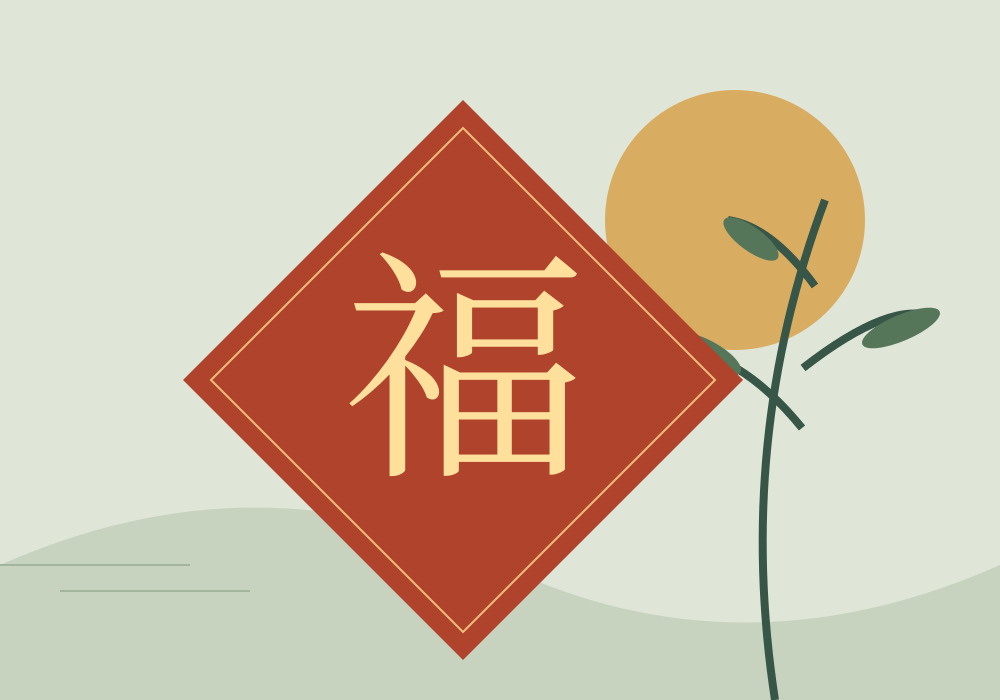
A red decoration bearing 福 can look puzzling when the character is upside down. Read fú in Mandarin, 福 means good fortune or blessing. The inversion makes sense through sound: 倒, meaning upside down, and 到, meaning to arrive, are both pronounced dào in this expression. [1]
So 福倒了, fú dào le, can suggest 福到了: good fortune has arrived. The character has not become a different word. Its position supplies the playful extra meaning, turning a written wish into something a visitor can also say aloud. [1]
Paper, doorways, and windows
The Chinese Canadian Museum in Vancouver presents the motif through a family paper-cutting activity. Its description places inverted fu in doorways or windows and connects it with welcoming luck into the home. That is a useful example of the custom in a Chinese diaspora setting, rather than a rule for every household. A paper decoration can be appreciated both as a greeting and as a piece of craft: notice how the character fits the surrounding design, where the open spaces fall, and how its shape changes when the paper is turned. [2]
One motif, different choices
Singapore Chinese Cultural Centre describes fu posters as popular New Year decorations and carefully says that some people prefer to display them upside down. Its exhibition guide also explores differences between Chinese Singaporean culture and other Chinese communities. That wording matters: a familiar shared symbol does not require identical choices everywhere. The Vancouver example and the Singapore guide make better starting points than a sweeping claim about what all Chinese people do. Treat a particular display as a clue to the people who made it, and leave room for a family to explain its own preference. [3]
The same idea can appear as a bat
This kind of sound-based imagery also appears in Chinese decorative art. A Smithsonian teaching guide explains that 蝠, bat, sounds like 福, good fortune. An inverted bat can therefore suggest that blessings have arrived, using the same arrival wordplay as the turned character. The guide also links a group of five bats with five blessings: long life, wealth, health, virtue, and a peaceful death. Seen this way, an unexpected animal or an unusual orientation may carry a wish rather than simply fill a decorative space. Looking for these connections can make a ceramic pattern or textile easier to read. [4]
Read the display in context
If you are joining someone else’s New Year preparations, follow their preferred arrangement. Ask what the decoration means to them before treating an upright character as a mistake or an inverted one as compulsory. The useful starting point is the wish for good fortune; the choice of position belongs to the particular home and occasion. A doorway, a window, and a room’s interior are also different settings; avoid assuming that the way one decoration is positioned tells you where every other one should go.
A couple of questions
What does an upside-down fu mean?
It commonly expresses a wish that good fortune has arrived, through the Mandarin wordplay between 倒, upside down, and 到, arrive. [1]
Must every fu decoration be upside down?
No. Singapore Chinese Cultural Centre describes inversion as a preference held by some people. Follow the custom of the household you are visiting. [3]
Sources & further reading
- The Arrival of 福 · Confucius Institute for Scotland, University of Edinburgh
- Lucky Red Decorations · Chinese Canadian Museum
- The Educator’s Guide: SINGAPO人 · Singapore Chinese Cultural Centre
- A Selected Illustrated Guide to Common Chinese Symbols · Smithsonian National Museum of Asian Art
Customs and interpretations vary. Have a correction or a source to share? Let us know.